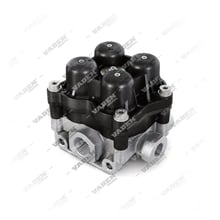
What is a 4-Circuit Protection Valve?
A 4-circuit protection valve (also called a 4-circuit protective valve or distributor valve) is a pneumatic control component in heavy commercial vehicle air brake systems that receives pressurized air from the compressor and proportionally distributes it to four separate brake circuits. Its primary function is to protect each circuit from pressure loss caused by leaks or component failure in other circuits. In trucks, tractors, buses, and trailers fitted with pneumatic brakes, this valve ensures balanced air supply to the front axle brake circuit, rear axle brake circuit, spring brake (park/auxiliary) circuit, and trailer supply circuit. Used extensively in Mercedes-Benz, MAN, Scania, Volvo, DAF, Iveco, Renault, BMC, and Ford heavy commercial vehicles, it is often integrated with Wabco or Knorr-Bremse air brake systems.
Functions and Operating Principle
- Distributes pressure to four circuits: Routes compressed air from the supply line to four separate outlets, delivering consistent braking force to each circuit independently.
- Circuit isolation on failure: When one circuit develops a leak or drops below minimum pressure, the valve automatically closes that circuit's outlet, preserving pressure and function in the remaining three circuits.
- Balances braking force: Maintains equal pressure across all circuits, allowing all wheels to brake with equal power and preventing skidding or loss of directional control.
- Load-responsive stability: Keeps brake balance stable whether the vehicle is loaded or empty, supporting safe stops under varying weight conditions.
- High-pressure durability: Engineered to withstand the high working pressures (typically 700–850 kPa) that heavy laden vehicles demand without leakage or performance degradation.
- Compact, integrated design: Mounts directly to the air processing unit or main brake manifold, saving space and reducing the number of separate components in the system.
Technical Specifications
| Specification | Detail |
|---|
| Component name | 4-circuit protection valve; 4-circuit distributor valve; 4-circuit protective valve |
| System type | Pneumatic (air) brake system for heavy commercial vehicles |
| Number of circuits | Four independent circuits: front brake, rear brake, spring brake (park/auxiliary), and trailer supply |
| Primary function | Distribute supply pressure to four circuits; isolate any circuit with a pressure loss |
| Integration | Connects to air compressor output and main brake control unit; part of the air processing assembly |
| Compatible vehicles | Mercedes-Benz, MAN, Scania, Volvo, DAF, Iveco, Renault, BMC, Ford commercial vehicles |
| Compatible systems | Wabco and Knorr-Bremse pneumatic brake systems |
| Construction | Compact body; high-pressure-resistant alloy; internal check valves and diaphragms |
Circuits and Internal Components
- Front brake circuit: Supplies pressurized air to the front axle brake chambers, controlling braking force on the steer axle.
- Rear brake circuit: Delivers air to the rear drive axle brakes, ensuring coordinated stopping power at the back wheels.
- Spring brake (park/auxiliary) circuit: Supplies pressure to spring brake accumulators and auxiliary brake actuators for parking and emergency braking.
- Trailer supply circuit: Provides air to the coupling interface on tractor units, allowing trailers and semi-trailers to operate their own independent brake systems.
- Internal check valves and diaphragms: One-way venting elements within each circuit outlet that automatically seal if pressure in that circuit drops, isolating it from the supply.
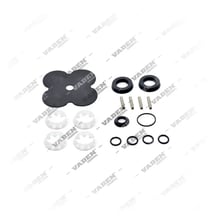
- Sealing components (O-rings, gaskets): Prevent air leakage between circuits and maintain system pressure integrity throughout operation.
Maintenance and Care
- Regular visual inspection: Check the valve body and all air line connections for visible dirt, corrosion, or damage; clean away debris and moisture.
- Pressure monitoring: Use a pressure gauge to verify that each circuit holds the manufacturer's specified pressure; note any drops or imbalances.
- Air line and fitting checks: Inspect all hose connections and quick couplers for looseness or leaks; tighten or replace as needed.
- Leak detection: Identify any hissing or persistent air escapes around the valve body or joint faces; test with soapy water if leaks are suspected.
- Air dryer integration: Monitor the air dryer performance alongside the valve; excess moisture or oil in the supply will compromise sealing and shorten component life.
- Manufacturer-recommended service: Follow the vehicle maker's service schedule for professional inspection and overhaul; some fleets schedule routine valve refurbishment every 250,000–500,000 km or annually.
Common Faults and Troubleshooting
- Continuous air leak: Caused by worn seals, diaphragms, or O-rings. Start by tightening all external fittings; if leakage persists, the internal sealing elements require replacement or the valve must be exchanged.
- One circuit loses pressure: The check valve or isolation mechanism for that circuit may be stuck or failed. Have the valve tested; a single faulty circuit typically requires valve replacement rather than field repair.
- Slow pressure rise: Internal blockage or contamination slows air flow. Isolate and flush the supply line; verify air dryer function; if the problem persists, suspect internal corrosion and replace the valve.
- Unequal braking: Asymmetrical pressure distribution between circuits causes uneven stops or pulling to one side. Confirm each circuit pressure is equal; if pressures are correct, wheel brake condition may be at fault.
- Cracked or dented body: Physical damage compromises the valve's seal integrity and internal geometry. A damaged valve cannot be reliably repaired and must be replaced.
- Dashboard warning light or low-pressure alarm: Always check the 4-circuit protection valve first when a low air pressure warning appears; confirm all four circuits hold pressure; test the supply line and air dryer.
Why Choose VADEN ORIGINAL?
- Premium material quality: Built from high-strength alloys that resist corrosion and withstand repeated high-pressure cycles in the most demanding operating environments.
- Heavy-duty design: Engineered specifically for the rigorous duty cycles of professional truck, bus, and trailer fleets with proven reliability in long-haul and local delivery services.
- Trusted performance: Delivers balanced, leak-free pressure distribution across all four circuits, supporting safe, consistent braking in all loading and road conditions.
- Wide vehicle compatibility: Designed to fit Mercedes-Benz, MAN, Scania, Volvo, DAF, Iveco, Renault, BMC, Ford, and other major commercial vehicle platforms.
- Easy installation and service: Compact form factor and standardized pneumatic connections simplify replacement and routine maintenance in the workshop or on the road.
- Genuine spare-parts support: VADEN ORIGINAL components meet OEM quality standards and come with full support, ensuring long-term reliability and cost-effective fleet maintenance.
Frequently Asked Questions (FAQ)
What does a 4-circuit protection valve do?
A 4-circuit protection valve distributes pressurized air from the compressor to four independent brake circuits—front, rear, spring brake, and trailer supply. If any circuit loses pressure due to a leak, the valve automatically isolates that circuit while maintaining full pressure and operation in the remaining three, ensuring the vehicle can still brake safely.
Is a 4-circuit protection valve the same as a 4-circuit distributor valve?
Yes, these terms are used interchangeably. Both refer to the same component: a pneumatic device that splits and protects air supply across four independent brake circuits. The names differ by region and manufacturer, but the function is identical.
What are the signs of a faulty 4-circuit protection valve?
Common warning signs include continuous air hissing from the valve, loss of pressure in one or more circuits, unequal braking force, slow pressure buildup, or a low-pressure warning light on the instrument panel. Any of these symptoms warrant immediate inspection and testing of the valve.
Which commercial vehicles use 4-circuit protection valves?
Heavy trucks, tractors, buses, and trailers equipped with pneumatic (air) brake systems use 4-circuit protection valves. They are standard in Mercedes-Benz, MAN, Scania, Volvo, DAF, Iveco, Renault, BMC, and Ford commercial vehicles, and compatible with Wabco and Knorr-Bremse brake systems.
How do I maintain a 4-circuit protection valve?
Regular maintenance includes checking all four circuit pressures against specification, inspecting air line connections for leaks, ensuring the air dryer removes moisture and oil, cleaning debris from the valve body, and having the system professionally serviced according to the vehicle manufacturer's schedule—typically every 12 months or 250,000 km.
What should I do if the 4-circuit protection valve develops an air leak?
Start by tightening all external connections and fittings. If the leak continues, the internal seals (O-rings, diaphragms, or gaskets) are worn and need replacement. For most field situations, installing a new VADEN ORIGINAL 4-circuit protection valve is the fastest, most reliable solution.
Conclusion
A 4-circuit protection valve is essential to pneumatic brake safety in heavy commercial vehicles. By isolating faulty circuits and maintaining balanced pressure across all four brake lines, it enables trucks, buses, and trailers to stop securely even when partial system failures occur. Regular monitoring, prompt attention to warning signs, and timely replacement of worn valves are key to fleet reliability. VADEN ORIGINAL 4-circuit protection valves combine premium materials, proven design, and wide vehicle compatibility to deliver the performance and longevity that professional drivers and fleet managers depend on. Invest in quality; choose VADEN ORIGINAL for a brake system that keeps your fleet moving safely.
Related technical guide: Four-Circuit Protection Valve · Download PDF
Related technical guide: Four-Circuit Protection Valve: Faults, Diagnosis & Replacement